A fourth chess lesson: favourite squares, and a gambit you can feel
Blog post #103
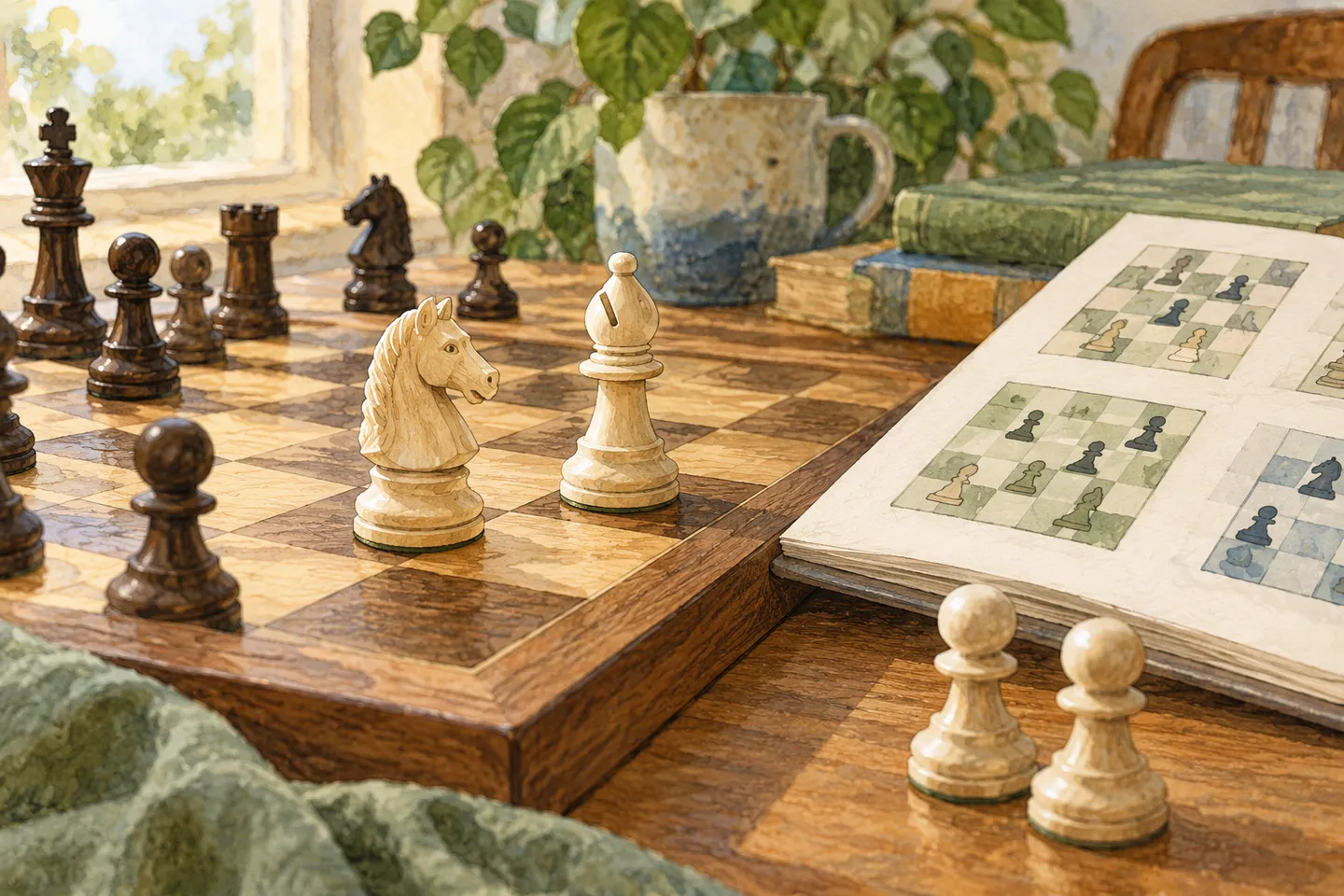
AI-generated illustration.
The fourth chess lesson started as two loose ideas. I wanted the children to learn where each piece likes to stand: the knight on c3, the bishop in the centre or in a fianchetto. And I wanted to talk about openings, and why a player sometimes gives away a pawn at the start to get the pieces out faster.
I also had an exercise in mind. I take away the pawns that are in the way, and the children feel how much faster their pieces come out. Claude Code built the lesson around that exercise. In one session I got a six-page trainer PDF, a three-minute Swedish film, and an upload to my YouTube channel, scheduled for Monday 2 November.
The free trainer PDF is already online.
What shipped
- A 45-minute lesson plan in Swedish. Warm-up: put a knight on a3 and count its jumps (four), then move it to c3 (eight). Then a table of favourite squares, the bishop shut in on c1 next to one on c4 aiming at f7, and a fianchetto on g2. After that, what an opening is, shown with the Italian Game, and what a gambit is, shown with the Nordic Gambit, where White is two pawns down but both bishops are out.
- My exercise, as Fartloppet (“the speed race”). Each child has their own board with only the white pieces. The task is to get all four minor pieces out and castle in as few moves as possible. With every pawn on the board it takes seven moves. Remove the pawns on d2 and e2 and it takes five. Two pawns gone, two moves faster: that is what a gambit buys.
- A follow-up game in pairs, the Gambit Match. White starts without the d- and e-pawns and Black has all of theirs. After eight moves each, the children count points from the second lesson: pieces out, pieces on a favourite square, castling. Then they play on and swap colours.
- A three-minute film in Swedish. Ten scenes with animated boards: the knight’s jumps, the fianchetto, the Italian Game, the Nordic Gambit, and both rounds of the speed race with a move counter. The narration is my voice clone on ElevenLabs v4.
- YouTube upload to @Stefan-Kroeker as a private video with a scheduled publish date, Swedish subtitles, and a place in the Swedish playlist. The lesson 3 description now links forward to lesson 4.
What’s working
- The chess is checked, not guessed. Every move sequence in the PDF and the film is played through a chess library first. That check caught a mistake in the booklet: it said the bishop on c4 reaches 7 squares and the fianchetto bishop 9. The real numbers are 10 and 8.
- The exercise is now a result the children can count. “Seven moves, then five” is easier to remember than “development matters”. The material from the second lesson comes back as the scoring system, so the lessons build on each other.
What’s unclear or broken
- Only Swedish so far. Lessons 1 to 3 have English versions too. Lesson 4 has no English booklet or film yet.
- The same deploy trap again. Claude Code put the PDF in the Aelg website repository and merged it, but aelg.se is published separately and the link returned a 404. I wrote about exactly this in post #86. This time it switched to this blog, which deploys from GitHub on its own, and the link worked within a minute. The PDF is still merged into the Aelg repository but not deployed there.
Decisions made
- Weekly schedule continues. Lesson 3 goes out on 26 October and lesson 4 on 2 November, both Mondays at 17:00.
- Narration stays on v4 with my clone, no voice settings. Same as lesson 3.
— Stefan